Introduction to Industrial Robots in Automation
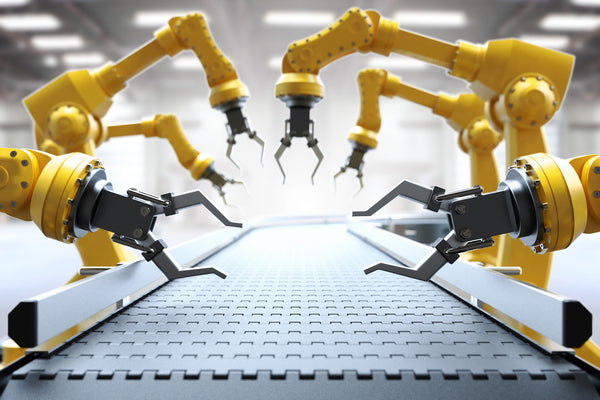
An overview of industrial robots, their types, applications, and role in modern automated manufacturing systems.
1. Introduction
Industrial robots are a core element of modern manufacturing and automation systems. They enable high precision, repeatability, speed, and consistency in tasks that are difficult, repetitive, or unsafe for humans. In automation engineering, robots are not standalone machines—they are integrated systems that work with fixtures, sensors, controllers, and production lines to achieve manufacturing goals.
This lecture introduces the fundamentals of industrial robots, their structure, applications, and role in automated production systems.
2. What Is an Industrial Robot?
An industrial robot is an automatically controlled, reprogrammable, multipurpose manipulator capable of moving materials, tools, or parts through programmed motions to perform various manufacturing tasks.
Key Characteristics
-
Programmable and flexible
-
Capable of multiple degrees of freedom
-
High repeatability and accuracy
-
Designed for continuous industrial operation
-
Integrates with automation hardware and control systems
3. Basic Components of an Industrial Robot
3.1 Mechanical Structure (Manipulator)
-
Rigid mechanical arm with joints and links
-
Provides motion and reach
-
Determines payload capacity and workspace
3.2 Robot Controller
-
The “brain” of the robot
-
Executes motion programs
-
Communicates with PLCs, sensors, and safety systems
3.3 Drive System
-
Electric servo motors (most common)
-
Harmonic drives, gearboxes, or belt drives
-
Enables precise joint motion
3.4 End-of-Arm Tooling (EOAT)
-
Grippers, welding guns, screwdrivers, suction cups
-
Tool selection depends on the application
-
Critical for performance and cycle time
3.5 Sensors and Feedback Devices
-
Encoders for position feedback
-
Proximity and presence sensors
-
Vision systems for guidance and inspection
4. Types of Industrial Robots
4.1 Articulated Robots
-
4 to 6 axes
-
Human-arm-like structure
-
Used in welding, assembly, painting, handling
4.2 SCARA Robots
-
High speed and rigidity in horizontal plane
-
Ideal for assembly and pick-and-place operations
4.3 Cartesian (Gantry) Robots
-
Linear motion along X, Y, Z axes
-
High accuracy and stiffness
-
Common in CNC loading and heavy payload handling
4.4 Delta Robots
-
Parallel kinematic structure
-
Very high speed
-
Used in packaging and food industries
4.5 Cylindrical and Polar Robots
-
Less common today
-
Used in specialized applications
5. Robot Axes and Degrees of Freedom
-
Each axis provides one independent motion
-
Most industrial robots use 6 axes:
-
Base rotation
-
Shoulder
-
Elbow
-
Wrist roll
-
Wrist pitch
-
Wrist yaw
-
Importance
-
Determines robot flexibility
-
Affects reachability and orientation
-
Influences fixture and workcell design
6. Robot Work Envelope and Reach
-
Work envelope is the 3D space the robot can reach
-
Defined by:
-
Arm length
-
Joint limits
-
Mounting orientation
-
-
Critical during:
-
Workcell layout design
-
Fixture positioning
-
Cycle time optimization
-
Poor reach planning leads to singularities, reduced accuracy, and production downtime.
7. Industrial Robot Applications
Common Applications
-
Spot and arc welding
-
Assembly and fastening
-
Material handling and palletizing
-
Painting and coating
-
Machine tending
-
Inspection and quality control
8. Role of Robots in Automation Systems
Industrial robots operate as part of a larger automation ecosystem:
-
Integrated with PLCs
-
Communicate using industrial networks
-
Work with fixtures, conveyors, and safety systems
-
Coordinated with sensors and vision systems
From an integration perspective, success depends on:
-
Mechanical design quality
-
Fixture repeatability
-
Accurate sensor placement
-
Robust control logic
9. Advantages of Industrial Robots
-
High repeatability and consistency
-
Increased productivity
-
Improved quality
-
Reduced labor fatigue and safety risks
-
Flexible reprogramming for new products
10. Limitations and Challenges
-
High initial investment
-
Requires skilled integration and programming
-
Sensitive to poor fixture design
-
Accuracy depends on mechanical rigidity
-
Needs proper maintenance and calibration
11. Importance of Mechanical Design in Robotics
Mechanical design plays a critical role in robot performance:
-
Poor fixture design leads to positional errors
-
Inadequate stiffness affects accuracy
-
Bad EOAT design increases cycle time
-
Incorrect tolerancing causes repeatability issues
Automation success is often determined more by mechanical integration quality than robot brand or software.
12. Summary
Industrial robots are essential tools in modern automation. Understanding their structure, types, and applications is fundamental for mechanical and integration engineers. Effective robot automation requires a system-level mindset where mechanical design, controls, and software work together to achieve reliable, efficient production.